
Global Geosynthetics Market to Reach USD 45.3 Billion by 2035 as Infrastructure Expansion and Environmental Protection Drive Demand
Growing demand for resilient infrastructure and eco-conscious construction drives widespread use of geosynthetics worldwide.
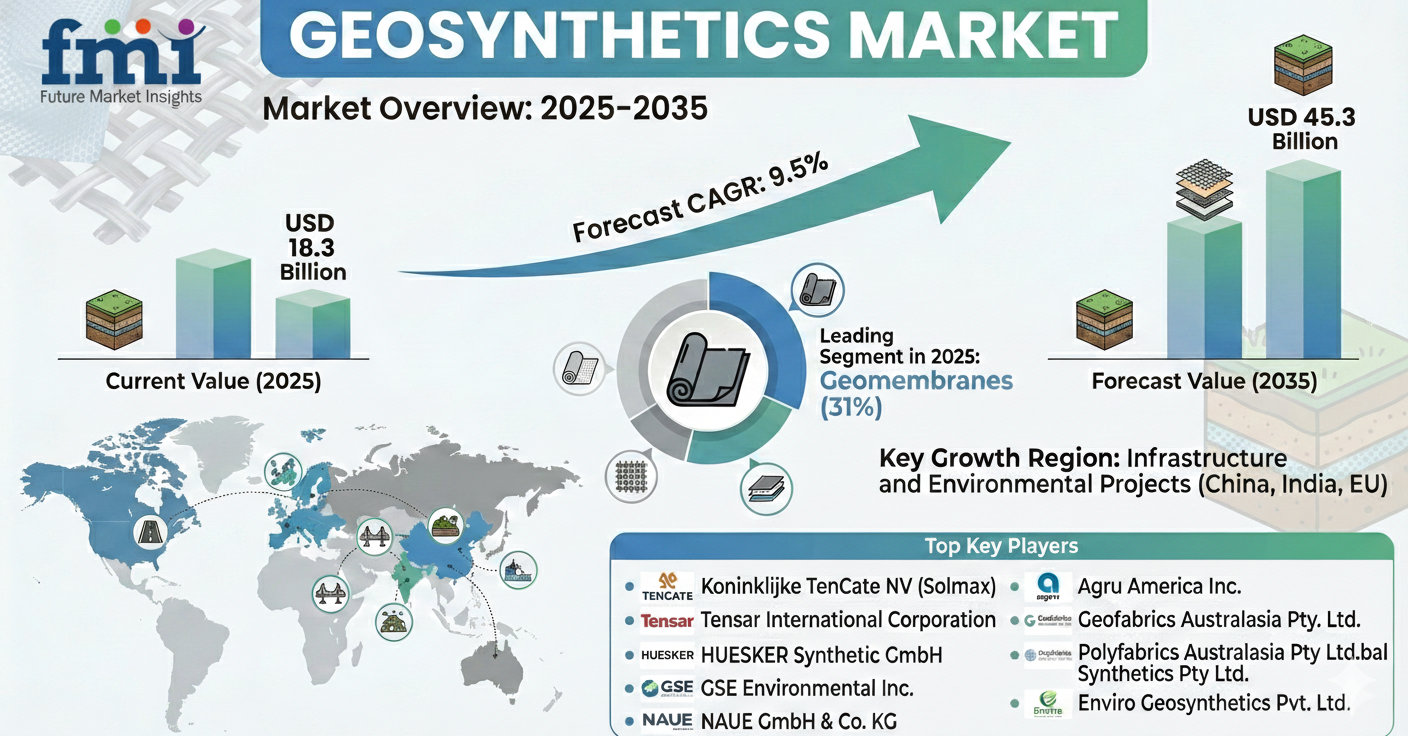
NEWARK, DE / ACCESS Newswire / February 6, 2026 / The global geosynthetics market is entering a sustained phase of infrastructure-led expansion, projected to grow from USD 18.3 billion in 2025 to USD 45.3 billion by 2035, according to a new industry outlook. This growth represents a robust compound annual growth rate (CAGR) of 9.5%, driven by rising investments in transportation infrastructure, increasing waste containment requirements, and tightening environmental and construction performance regulations worldwide.
Geosynthetics-including geotextiles, geomembranes, geogrids, and geonets-are becoming indispensable materials across roadways, railways, landfills, mining operations, coastal engineering, and water management systems. Governments and engineering firms are increasingly turning to these solutions to enhance soil stability, extend asset life, prevent erosion, and meet stricter sustainability benchmarks.
While transportation infrastructure remains a foundational demand segment, the next decade will see accelerating adoption across environmental protection, waste management, and climate resilience projects. Geosynthetics are increasingly positioned as critical enablers of durable, low-impact civil construction and long-term environmental stewardship.
Geomembranes and Polypropylene: The Structural Backbone of Market Growth
Geomembranes dominate the geosynthetics market, accounting for approximately 31%of total demand in 2025. Their impermeable properties make them essential in landfill liners, mining leach pads, wastewater treatment facilities, and water reservoirs, where preventing fluid migration and soil contamination is critical.
This segment continues to benefit from stricter environmental regulations and growing investments in global waste management infrastructure. Advancements in multilayer geomembrane structures and barrier-enhancing additives are further strengthening their role in long-term containment and geotechnical stability applications.
By material type, polypropylene leads the market with an estimated 47% share in 2025. Its balance of mechanical strength, chemical resistance, UV stability, and cost efficiency makes it the preferred polymer across geotextiles, geogrids, and geocomposites. Polypropylene-based products are widely deployed in road construction, erosion control, coastal protection, and embankment reinforcement, supporting infrastructure durability in chemically aggressive and high-load environments.
Infrastructure Applications Drive Rapid Adoption
Transportation and environmental projects are the primary growth engines for geosynthetics worldwide. In highway and railway construction, geotextiles and geogrids improve load distribution, drainage, and soil reinforcement, extending pavement life while reducing maintenance costs.
In landfill construction, geomembranes are increasingly used in base liners and capping systems to comply with leachate control and containment standards. Adoption has accelerated in response to stricter permitting requirements for municipal solid waste facilities across North America and Europe.
Sustainability and Regulation as Core Growth Catalysts
Geosynthetics are playing a central role in ESG-aligned infrastructure development. Key drivers include:
Environmental Protection: Enhanced containment and erosion control support soil and groundwater preservation.
Regulatory Compliance: ASTM, ISO, CE marking, and Geosynthetic Institute certifications ensure performance reliability and material safety.
Green Construction: Growing interest in recycled and biodegradable polymers aligns geosynthetics with circular economy goals.
Climate Resilience: Applications in flood mitigation, coastal defense, and slope stabilization support adaptation to extreme weather events.
However, the market faces challenges including volatile polymer raw material prices linked to crude oil, fragmented international testing standards, and evolving regulations surrounding plastic-based materials. These pressures are accelerating R&D efforts into bio-based geosynthetics and more harmonized global certification frameworks.
Regional Growth Engines: United States, Europe, and Asia Pacific Lead
The geosynthetics market is expanding globally, with infrastructure-heavy regions driving demand:
United States (10.1% CAGR): Federal investment under the Bipartisan Infrastructure Law is accelerating adoption in highways, flood management, landfill containment, and coastal protection.
European Union (9.6% CAGR): The EU Green Deal and Circular Economy Action Plan are promoting sustainable construction and recyclable geosynthetic materials, particularly in Germany, France, and Italy.
United Kingdom (9.2% CAGR): Growth is supported by flood protection projects and increased use of recycled geosynthetics in transportation infrastructure.
Japan (9.4% CAGR): Disaster preparedness initiatives are driving demand for slope stabilization, embankment reinforcement, and coastal defense systems.
South Korea (9.5% CAGR): Government-led Smart Infrastructure and Green New Deal programs are expanding applications in tunnels, roads, and mining-related containment.
Emerging economies, particularly China and India, continue to lead volume growth through aggressive infrastructure expansion and erosion control programs.
Innovation, Green Materials, and Smart Infrastructure Shape the Next Phase
Between 2025 and 2035, market growth will be increasingly driven by:
Advanced woven and nonwoven geotextiles with higher tensile strength and permeability
Sustainable product lines incorporating recycled or bio-based polymers
Digital monitoring technologies for geotechnical performance
Integrated drainage and reinforcement composites for complex infrastructure projects
Manufacturers are investing heavily in product development and technical support capabilities, enabling broader adoption across civil engineering and environmental applications.
Competitive Landscape and Market Evolution
Recent product launches-such as expanded geotextile, geogrid, and drainage composite portfolios-reflect the industry's shift toward application-specific solutions for road, rail, and coastal infrastructure.
As governments worldwide accelerate spending on resilient infrastructure and sustainable construction, geosynthetics are set to become a foundational component of modern civil engineering-supporting safer, longer-lasting, and environmentally responsible development over the coming decade.
Top Players in the Geosynthetics Market:
Koninklijke TenCate NV (Solmax), Tensar International Corporation, HUESKER Synthetic GmbH, GSE Environmental Inc., NAUE GmbH & Co. KG, Agru America Inc.,Geofabrics Australasia Pty. Ltd., Polyfabrics Australasia Pty Ltd.bal Synthetics Pty Ltd.Enviro Geosynthetics Pvt. Ltd.
For an in-depth analysis of evolving formulation trends and to access the complete strategic outlook for the Geosynthetics Market through 2035, visit the official report page at: https://www.futuremarketinsights.com/reports/geosynthetics-market
Related Reports:
Geosynthetics Industry Analysis in South Asia - https://www.futuremarketinsights.com/reports/south-asia-geosynthetics-market
Demand for Geosynthetics in South Asia - https://www.futuremarketinsights.com/reports/demand-for-geosynthetics-in-south-asia
Reinforcement Geosynthetics Market - https://www.futuremarketinsights.com/reports/reinforcement-geosynthetics-market
Geotextiles & Technical Textiles with Reduced Microplastic Release Market - https://www.futuremarketinsights.com/reports/geotextiles-technical-textiles-with-reduced-microplastic-release-market
Technical Textiles Market - https://www.futuremarketinsights.com/reports/technical-textiles-market
About Future Market Insights (FMI)
Future Market Insights (FMI) is a leading provider of market intelligence and consulting services, serving clients in over 150 countries. Headquartered in Delaware, USA, with a global delivery center in India and offices in the UK and UAE, FMI delivers actionable insights to businesses across industries including automotive, technology, consumer products, manufacturing, energy, and chemicals.
An ESOMAR-certified research organization, FMI provides custom and syndicated market reports and consulting services, supporting both Fortune 1,000 companies and SMEs. Its team of 300+ experienced analysts ensures credible, data-driven insights to help clients navigate global markets and identify growth opportunities.
For Press & Corporate Inquiries:
Rahul Singh
AVP - Marketing and Growth Strategy
Future Market Insights, Inc.
+91 8600020075
For Sales - [email protected]
For Media - [email protected]
For web - https://www.futuremarketinsights.com/
SOURCE: Future Market Insights, Inc.
Information contained on this page is provided by an independent third-party content provider. XPRMedia and this Site make no warranties or representations in connection therewith. If you are affiliated with this page and would like it removed please contact [email protected]
