
Global Digital Commerce Market Set to Quadruple by 2035 as AI, Cloud, and Mobile Payments Redefine Online Business
Surging from USD 4.7 Trillion in 2025 to USD 19.6 Trillion by 2035, Digital Commerce Accelerates on Intelligent Platforms, Secure Payments, and Omnichannel Experiences
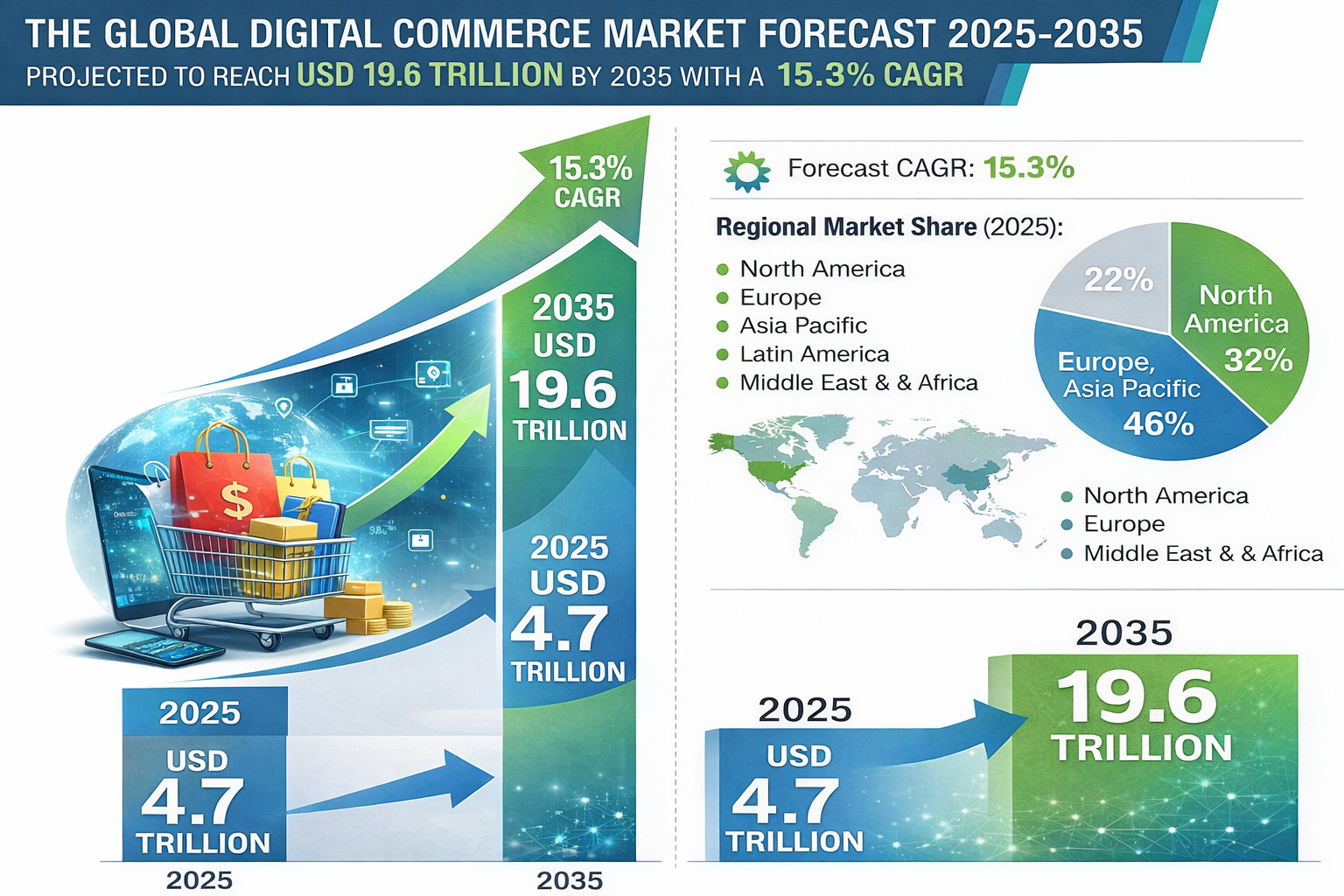
NEWARK, DELAWARE / ACCESS Newswire / February 6, 2026 / The global Digital Commerce market is entering a decade of accelerated and transformative growth, driven by rapid digitalization across industries, rising consumer preference for online and mobile shopping, and the widespread adoption of advanced software-driven commerce platforms. Valued at USD 4.7 trillion in 2025, the market is projected to surge to USD 19.6 trillion by 2035, registering a robust CAGR of 15.3% over the forecast period.
According to a comprehensive strategic outlook from Future Market Insights (FMI), digital commerce is evolving from basic online storefronts into intelligent, integrated, and data-driven ecosystems that combine e-commerce platforms, payment processing, mobile commerce, content management, logistics, and advanced analytics. Enterprises across BFSI, media, education, healthcare, manufacturing, and retail are accelerating investments in digital commerce solutions to enhance customer experiences, streamline transactions, and remain competitive in an increasingly digital-first economy.
From Online Transactions to Intelligent Commerce Ecosystems
The digital commerce industry is undergoing a structural shift fueled by AI, machine learning, cloud computing, and IoT integration. Traditional e-commerce models are being replaced by omnichannel, personalized, and automated platforms capable of managing the entire digital sales lifecycle-from discovery and engagement to payment, fulfillment, and post-sale services.
Businesses are increasingly adopting e-commerce software, mobile commerce platforms, and digital payment systems that enable seamless integration across devices and channels. The rapid rise of digital wallets, contactless payments, and real-time fraud detection solutions has further strengthened consumer trust and accelerated online transaction volumes globally.
As organizations pursue large-scale digital transformation initiatives, order management systems (OMS), inventory control, and logistics orchestration tools have become critical enablers of scalability and operational efficiency-particularly for enterprises managing high transaction volumes across global markets.
Intelligent Technologies Powering Next-Generation Digital Commerce
The integration of AI, ML, and IoT is redefining digital commerce experiences by enabling personalization, predictive insights, and automated operations:
AI-driven personalization allows platforms to analyze customer behavior, browsing patterns, and purchase history to deliver targeted recommendations, improving conversion rates and customer retention.
Machine learning algorithms support demand forecasting, dynamic pricing, inventory optimization, and fraud detection-reducing operational risks while enhancing transaction security.
IoT-enabled connectivity provides real-time visibility across logistics networks, warehouse automation, smart shelves, and connected payment systems, ensuring seamless order fulfillment and improved customer satisfaction.
Together, these technologies are transforming digital commerce into a responsive, intelligent, and customer-centric ecosystem.
Security, Compliance, and Regulation Shape Market Growth
Regulatory frameworks focused on data privacy, consumer protection, and fair competition are playing a central role in shaping the digital commerce landscape. Governments worldwide are enforcing strict policies around consent-based data usage, transparent product disclosures, ethical platform design, and cybersecurity compliance.
Data privacy regulations require robust governance, breach notification protocols, and user rights management, making cybersecurity and fraud prevention integral to digital commerce strategies.
Consumer protection laws mandate transparency in pricing, product information, returns, and warranties, helping build long-term consumer trust.
Competition and platform regulations restrict inventory control and anti-competitive practices, compelling global players to adopt compliant marketplace-based business models.
Compliance with these evolving standards is no longer optional-it has become a strategic differentiator for digital commerce providers.
Segment Spotlight: BFSI and B2C Drive Market Momentum
BFSI Emerges as a High-Growth End-User Segment
The BFSI sector is witnessing rapid adoption of digital commerce solutions as financial institutions prioritize secure digital payments, e-wallets, online banking, and digital lending platforms. Government-backed initiatives such as India's Unified Payments Interface (UPI) and Europe's PSD2 open banking framework are accelerating adoption and reshaping customer engagement models.
The BFSI segment is expected to grow at a CAGR of 17.2% (2025-2035), supported by rising transaction volumes and increasing reliance on digital-first financial services.
Business-to-Consumer (B2C) Dominates by Market Share
B2C digital commerce continues to dominate, accounting for an estimated 46% market share in 2025, driven by personalized shopping experiences, mobile commerce innovation, and AI-powered analytics. Government initiatives in the U.S., China, and Europe promoting digital marketplaces and cross-border e-commerce are further strengthening B2C dominance globally.
Regional Growth Dynamics - Digital Commerce Market (2025-2035)
Country | Expected CAGR | Key Growth Drivers |
|---|---|---|
India | 17.8% | Digital India initiatives, SME adoption, mobile payments |
China | 16.1% | Cloud-based managed services, cross-border e-commerce |
South Korea | 15.2% | Advanced digital infrastructure and mobile-first commerce |
United States | 14.7% | High digital penetration, compliance-driven consulting demand |
Germany | 13.0% | Strong enterprise digitization and regulatory alignment |
North America currently dominates the market due to mature e-commerce ecosystems and high digital adoption, while Asia-Pacific remains the fastest-growing region, supported by government initiatives, rising smartphone penetration, and expanding digital payment infrastructure.
The Road to 2035: AI, Cloud, and Integrated Commerce Platforms
Looking ahead, the digital commerce market will be shaped by:
AI-driven personalization and predictive analytics
Cloud-based managed and consulting services
End-to-end integrated solutions combining logistics, inventory, and order management
Advanced cybersecurity and fraud prevention frameworks
Subscription-based and platform-as-a-service (PaaS) commerce models
While challenges such as cyber threats, regulatory complexity, and integration costs persist, industry leaders are responding with zero-trust security models, scalable cloud architectures, and strategic partnerships that blend commerce, data, and digital intelligence.
Competitive Landscape
The market remains highly competitive, led by global technology giants and specialized platform providers.
Key Players Include:
Shopify, Adobe, Salesforce, Microsoft, Oracle, SAP, Magento (Adobe), WooCommerce, BigCommerce, Wix
These companies are actively investing in AI-powered commerce engines, cloud-native platforms, personalization tools, and secure payment ecosystems to strengthen market positioning and expand global reach.
For an in-depth analysis of evolving formulation trends and to access the complete strategic outlook for the Digital Commerce Market through 2035, visit the official report page at: https://www.futuremarketinsights.com/reports/digital-commerce-market
Related Reports:
Digital Commerce Platform Market - https://www.futuremarketinsights.com/reports/digital-commerce-platform-market
UK Digital Commerce Market - https://www.futuremarketinsights.com/reports/uk-digital-commerce-market
USA Digital Commerce Market - https://www.futuremarketinsights.com/reports/usa-digital-commerce-market
India Digital Commerce Market - https://www.futuremarketinsights.com/reports/india-digital-commerce-market
Demand for Digital Commerce in Japan - https://www.futuremarketinsights.com/reports/japan-digital-commerce-market
About Future Market Insights (FMI)
Future Market Insights (FMI) is a leading provider of market intelligence and consulting services, serving clients in over 150 countries. Headquartered in Delaware, USA, with a global delivery center in India and offices in the UK and UAE, FMI delivers actionable insights to businesses across industries including automotive, technology, consumer products, manufacturing, energy, and chemicals.
An ESOMAR-certified research organization, FMI provides custom and syndicated market reports and consulting services, supporting both Fortune 1,000 companies and SMEs. Its team of 300+ experienced analysts ensures credible, data-driven insights to help clients navigate global markets and identify growth opportunities.
For Press & Corporate Inquiries
Rahul Singh
AVP - Marketing and Growth Strategy
Future Market Insights, Inc.
+91 8600020075
For Sales - [email protected]
For Media - [email protected]
For web - https://www.futuremarketinsights.com/
SOURCE: Future Market Insights, Inc.
Information contained on this page is provided by an independent third-party content provider. XPRMedia and this Site make no warranties or representations in connection therewith. If you are affiliated with this page and would like it removed please contact [email protected]
